The morning of your child’s first preschool day arrives faster than you expect. You have packed the bag, picked out the outfit, and rehearsed your cheerful goodbye — and yet, standing at the door, you may feel every bit as nervous as your little one. That mix of excitement and worry is completely normal. Knowing what actually happens on day one can replace the uncertainty with confidence, and at Kids Village™, we have built every detail of the first-day experience around making both your child and your family feel genuinely welcomed.
Kids Village is a private preschool in Orem, Utah that has been serving Utah County families since 2003. Voted Best Preschool in Utah Valley from 2016 through 2026 by Utah Valley Magazine and awarded Best Private Preschool by Best of State every year from 2015-2026, we have welcomed thousands of children through those first-day doors, and we understand exactly what parents are wondering about as they drive home after drop-off.
In This Article:
• What happens during drop-off
• How your child spends their first morning
• What the learning environment looks like
• How teachers support children who need extra time to adjust
• What you can do before day one to prepare your child
• Frequently Asked Questions
Drop-Off: Designed to Feel Safe from the First Moment
At Kids Village, drop-off is not a rushed handoff at a parking lot curb. Our valet drop-off system means a staff member meets your vehicle, greets your child by name, and walks them inside personally. For children who are hesitant or anxious, that escort helps to ease the transition. There is no chaotic lobby scramble, no navigating a crowd of unfamiliar families. Your child moves from your car to a known face in under a minute.
That personal greeting is intentional. Children regulate emotionally through trusted adults, and meeting a warm, familiar voice at the door even on day one signals that this place is safe. Your child’s teacher will be waiting just inside, ready to introduce them to their space and their new classmates.
One small detail that carries surprising weight: every child at Kids Village receives a personalized book bag as a welcome gift. It arrives with their name on it. Holding something that is unmistakably theirs gives a child an anchor, a small sense of belonging in a new environment.
The First Morning: Structure and Discovery
Children thrive when they know what comes next. A predictable rhythm reduces anxiety far more reliably than any reassurance. That is why the Kids Village daily schedule is organized around clear transitions between activities, helping children quickly learn what follows what, and that familiarity is calming.
On a first morning, your child will move through between academic classrooms and a handful of our workshops. These workshops rotate across subjects and experiences: science exploration, art, music, cooking, history, and more. Rather than sitting in one room for hours, children move through a series of shorter, focused activities. That variety keeps engagement high and gives every child a chance to find something they love within the first hour.
Each workshop draws on five-senses learning, the methodology at the heart of our curriculum. Children do not simply hear information; they touch, taste, observe, and interact with it. On a first day, that might look like pressing dough in our full-sized gourmet kitchen, examining a seed in the science lab, or tracing letters in a sensory tray. The hands-on nature of the day gives children something to do from the moment they arrive, which naturally reduces self-consciousness and the impulse to fixate on missing a parent.
The Environment: A Place That Feels Different
Walking into Kids Village for the first time, children often pause. The school is built like a storybook village. Cobblestone paths wind between cottage-style classroom storefronts, twinkle lights line the ceiling, and a life-sized oak tree stands at the center of the “town square.” It does not look like a standard classroom, but like a magical village they are becoming a part of.
Young children respond to environment. A space that sparks curiosity and feels magical signals that this is a place where interesting things happen. For a hesitant child, that wonder can be the thing that loosens the grip on a parent’s hand.
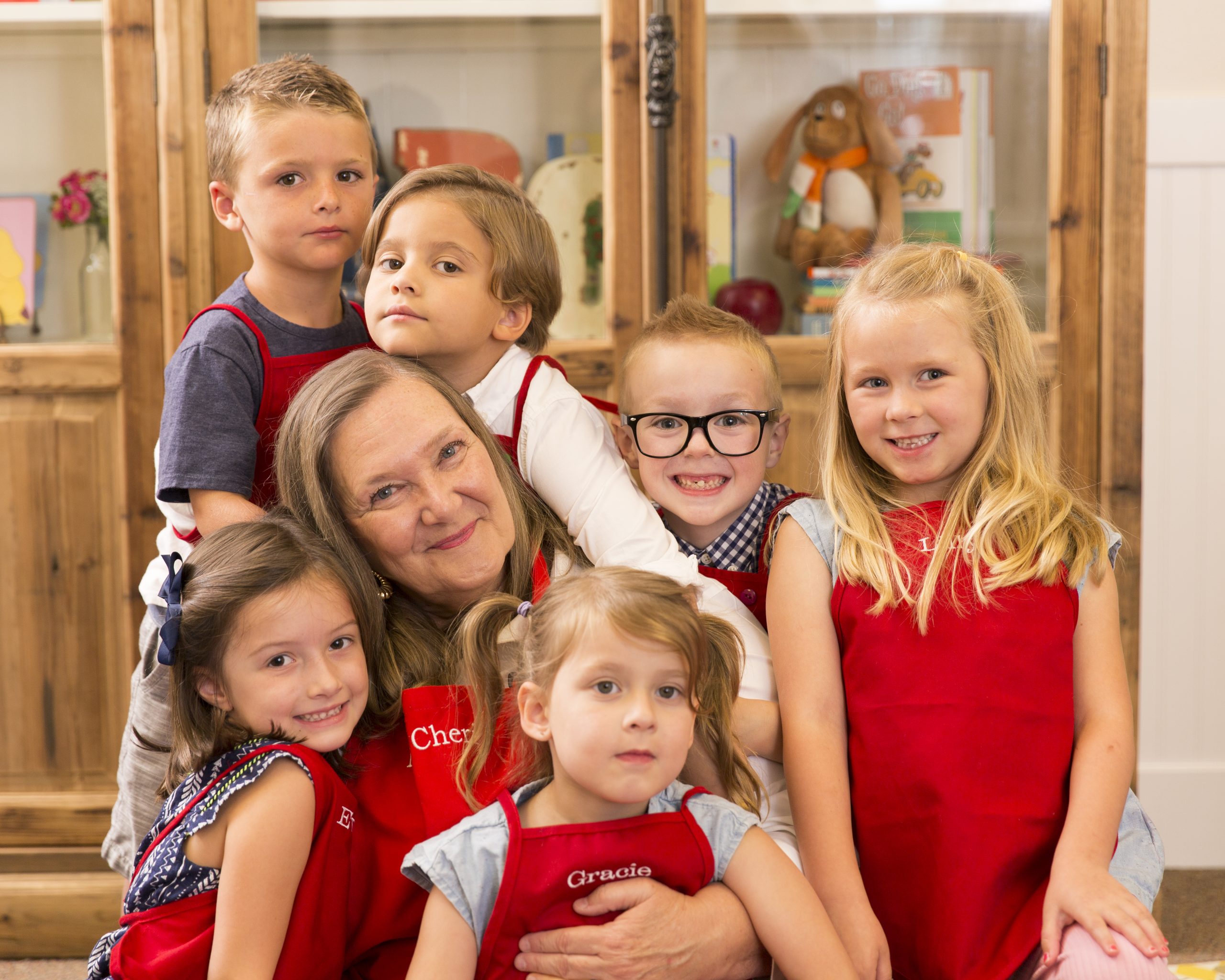
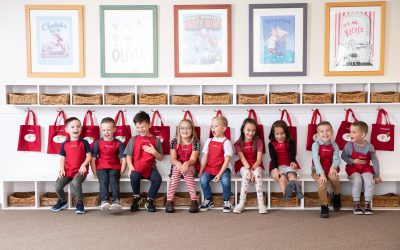
Your child will also receive a red apron embroidered with their name, worn by students and teachers alike. The apron serves as both a practical tool and a symbol of belonging. When every person in the building wears one, there is no hierarchy of insiders and outsiders, just a community of people working and learning together.
To explore what your child’s day looks like across all age groups, visit our programs page, where each program is described in detail.
How Teachers Support Children Who Take Longer to Adjust
Some children walk in confidently on day one. Others need a week or two before they stop looking for you at drop-off. Both are completely typical, and our teachers are trained to meet each child where they are.
Kathleen Jensen, who directs Kids Village and brings more than 30 years of experience across public and private educational settings, has emphasized that no two children arrive at the same readiness level, and that patience in the early weeks produces lifelong confidence in the school environment. Teachers here do not rush children through an adjustment period or treat hesitance as a problem to solve. They treat it as information about what that child needs.
In practical terms, this looks like a teacher staying physically close to a new child during transitions, offering choices rather than directives, allowing a child to observe rather than being forced to dive in, and introducing new children to one peer at a time rather than the full group at once. Children who need extra time to warm up are never separated or singled out. They are simply given more of what works: proximity, routine, and patient attention.
What You Can Do Before Day One
Preparation at home makes a genuine difference. Several weeks before the first day, begin talking about Kids Village in concrete, specific terms. Skip abstract reassurances (“You’ll love it”) in favor of descriptions your child can picture: “Your classroom looks like a little cottage shop, and you’ll get to wear a red apron with your name on it.”
Practice the goodbye. Keep it short and confident. A long farewell communicates uncertainty to your child, even when you mean it to communicate love. A warm hug, a reminder that you (or another loved one) will pick them up after school, and a confident wave give your child a clear mental picture of what comes next. Children do not fear endings nearly as much as they fear uncertainty.
Visiting the school before day one is one of the most effective preparation tools available. A tour lets your child walk the cobblestone paths, see the oak tree, and explore the classrooms. Coming during our “Meet the Teacher” event allows your child to meet their teachers and get familiar with the workshops before there is any performance pressure. Families who visit first consistently report shorter adjustment periods. You can schedule a tour any time to set that foundation before the first morning arrives.
Frequently Asked Questions
These answers address what parents ask us most often. For a broader list of questions about enrollment, tuition, and daily logistics, visit our frequently asked questions page.
What should my child bring on the first day of preschool?
Kids Village provides your child with a personalized book bag at enrollment, so you do not need to supply a standard school backpack. Your child should arrive in comfortable, activity-friendly clothing they can move and create in freely. Workshops include art, cooking, and outdoor exploration, and while children wear a personalized apron while they are here, there’s still the possibility of getting a little messy.
How long does it typically take for children to adjust to preschool drop-off?
Most children at Kids Village find their footing within a week or so. The predictable daily schedule helps enormously. Once a child knows the routine, the anxiety that comes from uncertainty drops significantly. Children who visited the school for a tour before their first day and participated in the Meet the Teacher event often settle more quickly, because the environment and at least one teacher’s face are already familiar. If your child is still struggling with goodbyes beyond the third week, please speak with your child’s teacher directly. Our staff works with families individually to find what helps.
What makes Kids Village different from other Utah County preschools?
Several things set Kids Village apart from a typical Utah County preschool option. First, the physical environment is unlike any other school in Utah Valley. It is a fully realized storybook village with cobblestone paths, cottage-style classrooms, and a life-sized oak tree at its center. That environment is not decorative; it is a teaching tool that keeps children engaged and emotionally invested in being there. Second, the academic structure is built around scientifically proven five-senses, hands-on learning, and Saxon early learning curriculum, a nationally respected approach with more than 30 years of proven results in early literacy and math. Third, children move through academic classrooms and workshops each day, which means more variety, more modalities of learning, and more opportunities for each child to discover what they are genuinely good at. Kids Village has been awarded Best Private Preschool in Utah by Best of State from 2015 through 2026, and voted Best Private Preschool in Utah Valley by Utah Valley Magazine for the same time period — a record that reflects not just a strong program but a consistent one. Families in Orem, throughout Utah County, and across the Wasatch Front choose Kids Village because the results speak clearly: children regularly enter public school ahead of their grade-level peers.
Is there a way to prepare my child if they have never been in a group setting before?
Yes, and the single most effective step is a visit before day one during a tour and our Meet the Teacher event. Walking through the school, meeting a teacher, and seeing the space removes the biggest source of first-day anxiety: the unknown. Beyond that, books about starting school can help younger children build a mental model of what to expect. Short practice separations, such as leaving your child with a trusted adult for a defined stretch of time, also help build the confidence that you will always come back. Our staff is happy to answer specific questions about individual children during your tour. Schedule a tour to speak with us directly about your child’s needs before the first day arrives.
About the Author

Mikelle Despain
Author at Kids Village
Mikelle Despain has contributed expert articles on early childhood education to Kids Village for over a decade. With a background in child care and child development, as well as firsthand experience as a mother of four, she offers thoughtful, family-centered insight to help support parents and young learners.
You may also be interested in...

Age-Appropriate Garden Chores for Young Children
Spring is (nearly) upon us, which means planting season is just around the corner! Involving your child in growing a vegetable garden provides many emotional, educational, and physical benefits to the child, regardless of age! Young babies can benefit from sensory...
8 Reasons Why It’s Important for Children to Help in the Garden
Encouraging your child to help you in the garden doesn’t only get them outside; it also extends their attention span, teaches them delayed gratification, and more.

Presidents Day for Kids
As far as holidays go, Presidents Day isn't one that springs to mind as a "kids holiday," especially right after a candy-filled Valentine's Day. However, it's an important holiday in our history, and with a little creativity, it can be fun for your children! What is...

Strengthening Pre-Writing Skills at Home
Many of our parents ask what they can do at home to help their children excel at school, and our answer is almost always to READ! Reading is so, so important for students. Reading with your child not only helps to develop their language skills, but it also helps...

4 Things You Might Have Missed During Your Kids Village Tour
At Kids Village, we invite prospective families to come to our school for a tour at any time (you don't even have to give us notice if you come during school hours). We think it's important for parents and children to see classrooms and workshops in action as part of...
12 Ideas for Keeping Children Occupied on Thanksgiving
We don't know about you, but Thanksgiving can be...well...a little chaotic at our houses, especially with so many little ones in the mix. while it can be tempting to turn on a movie marathon and settle the kids onto beanbag chairs with a little Chex mix (no judgment...
Helping Your Child Transition Into Preschool
Transitioning into preschool can be scary for the parent, but it can be especially cumbersome for young children. They haven’t been exposed to many new things before, and you, as their parent, have been such a consistent presence in their life that it may be difficult...
How to Teach Kids to Share
Any time there is more than one child in the room, there’s likely to be some tension over some knick-knack or other. Kids under the age of 5 are just starting to develop their sense of self. They’re starting to explore and experiment with what that means for them and...

4 Ways to Enhance Your Child’s Ability to Focus
Being able to focus helps increase productivity, reduce stress, and helps you produce a better quality of work. When you are able to pay attention to just the task at hand, you’re able to dedicate your whole self to whatever it is you’re doing. Cultivating mindfulness...
How to Raise Self-Motivated Children
Raising kids who have the wherewithal to work past challenges and persevere can be a fine line to walk. You don’t want to be overbearing and force your kids to succeed; that’s a miserable and exhausting experience for both of you. It’s a balancing act: giving your...
5 Life Skills to Start Teaching Now
Parents have a lot of responsibility. We have to address our children’s immediate needs: feeding them (which sometimes feels nonstop), clothing them, and educating them. Outside of conventional education like learning the ABCs, multiplication tables, and the formula...

Six Toddler Friendly Science Experiments
Six Toddler-Friendly Science Experiments Cultivating your toddler’s interest in science may seem a bit overwhelming. They don’t have a lengthy attention span. Their limited interactions mean that there’s not much foundational knowledge from which to build, but that...