
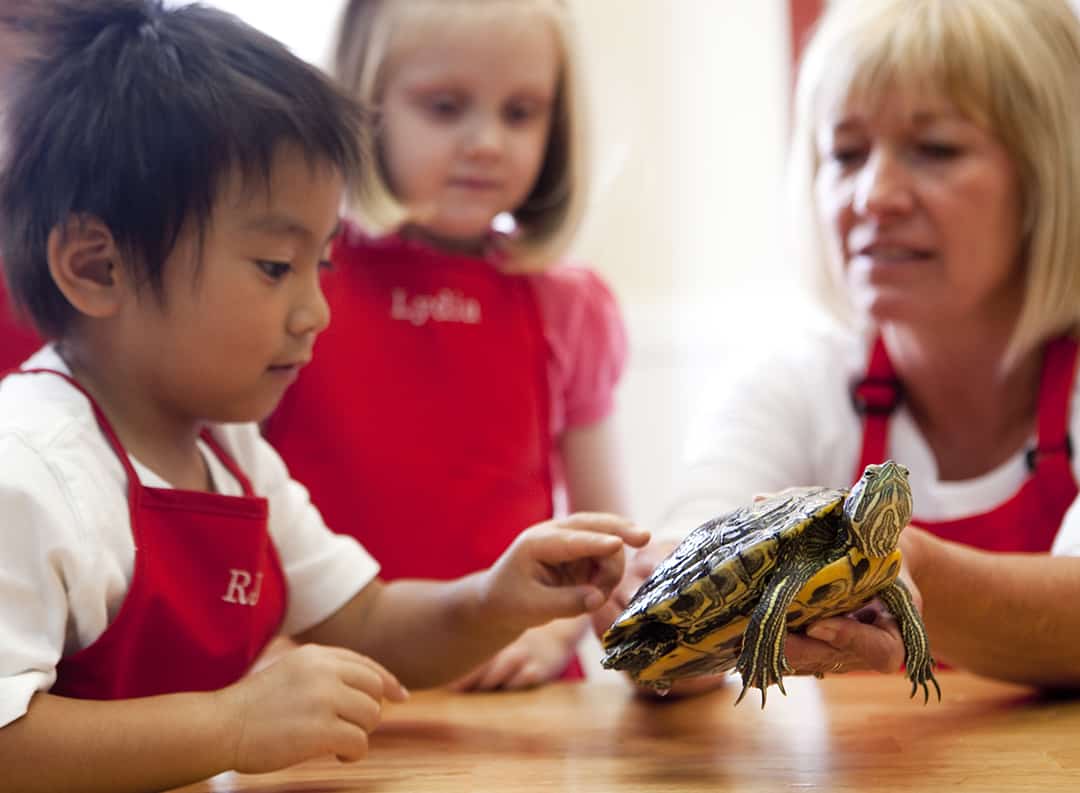
Springtime means it’s the perfect time to get outside and explore. We love when our students come to us with questions about what they’ve observed.
Sometimes all the “whys” can seem overwhelming—especially when you’re a parent trying to do a million things at once—but remember that the way you answer your child’s questions will help fuel their curiosity for learning for the rest of their lives.
Indulge in and celebrate your child’s “whys” by answering them as patiently as possible when you can.
Why are the “Whys” so important?
In a study by the Department of SSHA, University of California, they found that questions are important for our children’s cognitive development. That’s because when your child is asking a question, it’s to fill a knowledge gap exactly when they need it. This means that when your child is asking a question, there is no time they will be more receptive to learning than at that exact moment.
When children encounter a problem with their current knowledge state (a gap in their knowledge, some ambiguity they do not know how to resolve, some inconsistency they have detected), asking a question allows them to get targeted information exactly when they need it. This information is available to them when they are particularly receptive to it, and because it comes as the result of their own disequilibrium it may have depth of processing benefits…
Questions allow children to get information they need to move their knowledge structures closer to adult-like states. The ability to ask questions to gather needed information constitutes an efficient mechanism for cognitive development.
– Children’s questions: a mechanism for cognitive development. Chouinard MM., Monogr Soc Res Child Dev. 2007;72(1):vii-ix, 1-112; discussion 113-26.
In this study, researchers found that when children are encouraged to ask questions and receive helpful information when they do, that they learn more efficiently and productively than they would learning the same information at any other time.
We know it can be downright intimidating to know the right answer to all of your child’s questions. The why’s can seem downright daunting, and have been known to get more existential than we mere adults know how to handle (“How do I know that I’m real and not just a dream of someone else?” …well…). However, answering as many questions as possible with the best information you have at the time is one of the best ways to support your child’s learning. That’s because answering the why’s:
- Encourages curiosity. Your child wants to learn, and asking questions helps him or her do that. Answering questions helps to fuel the curiosity, where “not nows,” or frustrated “I don’t know’s” signify that the question isn’t important, shouldn’t be asked, or that the curiosity is only an annoyance or something looked down on.
- Fosters creativity. It may seem like your child is only trying to seek attention with one why after another, but your child is still processing the information you give him or her. Hearing and understanding different answers to different questions will open up the world to your child, encouraging them to look beyond what’s right in front of them, seek questions, and learn.
- Offers connection between parent and child. Okay, so maybe the “why” game isn’t your favorite, but it’s a great opportunity to connect with your child. It shows them you respect their mind and their questions, and shows that you are there for them to help make sense of the world around them. If you don’t know the answer to a question, head to the library or to a computer to look up the information together. You never know what that extra little bit of attention and discovery will spark in your child.
- Strengthens learning. As mentioned in the study above, there is no time your child is more receptive to learning than when they are asking a question. Take advantage of the opportunity and fuel your child’s mind!
- Encourages problem solving and information seeking. Answering questions to your child’s “why’s” sets a pattern of information fulfillment when your child has a question. This means as they grow, when they have a question, they will seek an answer! Conversely, if a child is used to having his or her questions ignored or brushed off, they’ll be less likely to seek answers or solutions since they haven’t experienced a pattern of resolution.
But no pressure!
You don’t have to be a scientist to answer your child’s questions; just do the best you can with the knowledge you have. If you don’t have the answer, take the time to find the answer with your child! Make a quick stop to find a book at the library, or take a moment to look up the answer online. Not only will this be a special and connecting moment between you and your child, but it also reinforces that their questions are important, that curiosity is good, and that answers can be found with a little bit of work. It also reinforces that knowledge doesn’t simply come from growing older, it comes from learning, studying, and researching.
5 of our favorite spring-inspired “Why?” kids questions:
Here are some science questions our students have asked (and their answers) that are perfect for spring.
1. Why do flowers have bright colors?
Flowers that are bright in color attract birds, bees, and insects that will which will lead to the transfer of pollen from one plant to another. The only way flowers can produce seeds is if they are pollinated from their own flower (self-pollination) or from another flower in the same species.
2. Why don’t birds get shocked when they sit on an electrical wire?
Because when a bird sits on a single wire, its two feet are at the same electrical potential as the wire, so the electrons have no reason to travel through the bird’s body (electrons travel on the path of least resistance — the wire). The only way electricity would move through the bird’s body is if part of the bird touched something with a different electrical potential (like a different wire, the ground, or the wood post). That would open up an easier path for the electrons to travel through.
3. Why is the sky blue?
Light from the sun looks white, but it’s actually made up of all the colors of the rainbow. Light travels in waves (just like waves in the ocean) — some light travels in short, “choppy” waves; others light travels in long, lazy waves. The waves will travel in a straight line unless it is reflected (like with a mirror), bent (like with a prism) or scattered. Blue light waves are shorter than other color light waves, so when these waves hit the particles in the atmosphere, the blue light waves scatter more than other colors. That’s why we see a blue sky most of the time.
4. Why do we get sunburns?
The sun produces three types of waves: Infrared radiation, visible light (which we can see and which causes the blue sky and rainbows), and Ultraviolet light. Infrared radiation produces the less energy than visible light waves, and ultraviolet waves produce more energy than visible light or ultraviolet light. It’s this energy that can hurt us. If too much ultraviolet light hits our skin, it can cause our skin cells to die and our bodies to react. Our skin turns red and it can hurt a lot. Ultraviolet light can bounce off surfaces like water, snow, and concrete, which means even under an umbrella (or even if there are clouds) you can still get burned.
5. Why do stars twinkle?
Most stars shine with a steady light, but since we are viewing stars through thick layers of atmosphere that have turbulent (moving) air, some of the light bends slightly as it travels to us on the ground. This makes the star seem to twinkle. You may also notice that stars closer to the horizon seem to twinkle more than other stars. That’s because there is more atmosphere between you and a star on the horizon than between you and a star high in the sky above you.
Would you like to explore some more fun science?
Check out NASA’s kids’ site, https://spaceplace.nasa.gov
You may also be interested in…
How to Encourage Reading at Home