Choosing where your child spends their first years of school is one of the most important decisions you will make as a parent. In Utah County, families typically weigh two options: a publicly funded charter preschool or a private preschool that operates independently. These two models differ in more ways than most parents realize, and understanding those differences before enrollment season can save you time, frustration, and — most importantly — a poor fit for your child.
Kids Village™ has served Orem families as a private preschool in Orem Utah since 2003, and in that time the question comes up constantly: “How is a private preschool different from a charter school?” The answer matters, because the right environment shapes not just what your child learns, but how they feel about learning for years to come.
In This Article:
• What charter preschools in Utah actually are
• How private preschools operate differently
• Curriculum and classroom experience: a side-by-side look
• Enrollment, eligibility, and what to expect from each
• The environment question: why it matters more than most parents think
• What Utah County families should ask before choosing
• Frequently Asked Questions
What “Charter Preschool” Actually Means in Utah
The term “charter preschool” gets used loosely, and that looseness causes real confusion. In Utah, charter schools are publicly funded and state-authorized. They must follow the state’s Core curriculum standards, employ licensed educators under Utah State Board of Education requirements, and meet eligibility criteria that may include age minimums, income thresholds, or disability designations depending on the specific program. Some charter schools offer preschool-aged programming, but these are often tied to special education services or are limited to specific populations.
Because charter preschools receive public funding, they operate under a different accountability structure than private schools. That structure has benefits, no tuition cost being the most obvious one, but it also comes with constraints. Class sizes, curriculum frameworks, lottery-based enrollment, and scheduling are often set at the district or state level rather than by the school itself. A charter preschool director may have limited ability to customize the classroom experience in ways that would benefit your specific child.
How Private Preschools Operate
Private preschools function outside the public funding system. That independence is exactly the point. Without the requirement to meet state-mandated curriculum benchmarks in a prescribed way, private preschools can choose their own academic philosophy, design their own daily schedule, and adapt their approach based on what actually works for young learners.
At Kids Village, that independence has meant adopting the Saxon Early Learning curriculum, a nationally recognized math, reading, and phonics program with more than 30 years of proven results, alongside a five-senses learning methodology that has children cooking, experimenting, and participating in a wide range of workshops alongside traditional academic instruction. State curriculum doesn’t mandate determine the approach. Rather, the programs are based on decades of experience and teaching thousands of Utah County children.
Private preschools are also accountable differently. Rather than answering to a state board, they answer to enrolled families. When a school like Kids Village has maintained full enrollment since 2008 with a waitlist filled primarily by referrals, that is the accountability structure in action. Parents who see results tell other parents.
Curriculum and Classroom Experience: What Each Model Delivers
The Charter Model: Standardized by Design
Charter preschool programs in Utah typically follow state early childhood standards, which set broad developmental goals for children across literacy, numeracy, and social-emotional learning. Those standards establish a baseline of quality across programs with very different resources. The tradeoff is that instruction tends toward a standardized format. A teacher working within a state framework has limited room to go deeper on a subject that captivates a particular group of children, adapt learning based on the learning styles of their students, or to introduce life skills that fall outside the defined curriculum.
The Private Model: Built Around the Child
Private preschools can design their curriculum from the ground up. At Kids Village, that design means different academic classrooms and life skills workshops across subjects that include reading, phonics, math, science, history, cooking, music, music, drama, art, and personal values. A typical public preschool or charter program offers a fraction of that variety.
Our curriculum goes deeper on academics than most Utah County families expect from a preschool. Children regularly enter public school ahead of their grade-level peers because the hands-on phonics and math programs build skills systematically, year over year, starting with the youngest learners. That outcome is something charter programs with broader mandates are rarely positioned to deliver.
To learn more about how the five-senses learning methodology is woven through every part of the school day, visit our curriculum page.
Enrollment and Eligibility: A Practical Comparison
Charter preschool enrollment in Utah depends on the individual program. Some require children to meet specific eligibility criteria related to developmental needs, family income, or geographic boundaries. Seats are limited, waitlists are common, and the calendar for enrollment often follows the public school district’s timeline.
Private preschool enrollment is simpler. If your child is the right age and the school has availability, you enroll. At Kids Village, we serve children from age 2½ through 2nd grade across several programs designed for different developmental stages. Scheduling options include Tuesday/Thursday half-day, Monday/Wednesday/Friday half-day, and Monday through Friday with both half-day and full-day options for older students.
The enrollment process at Kids Village begins with a tour, not a form. Families who visit the school in person consistently say the physical environment answered questions they did not know they had.
The Environment Question
Most comparisons between private and charter preschools focus on curriculum and cost. Far fewer address the physical environment, which is one of the most underrated factors in early childhood education.
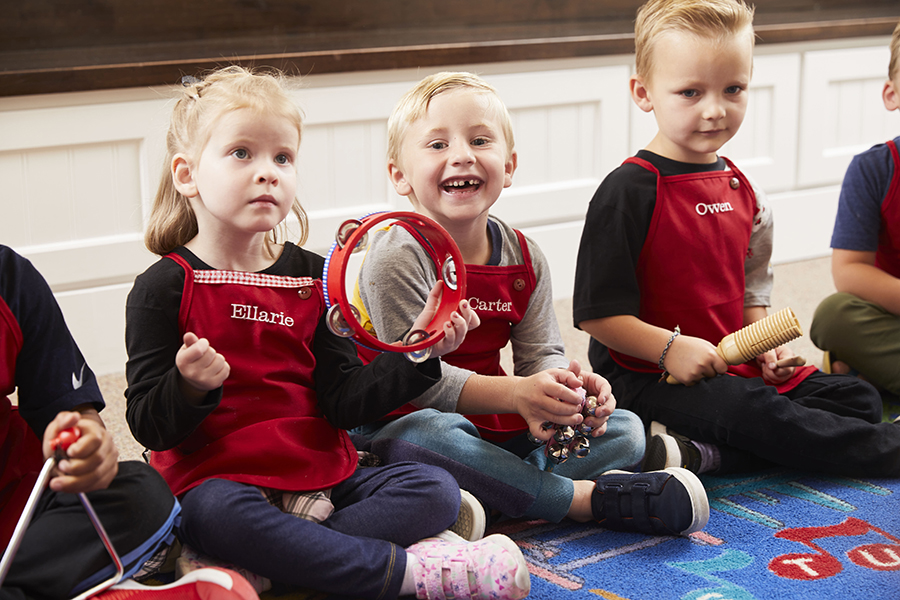
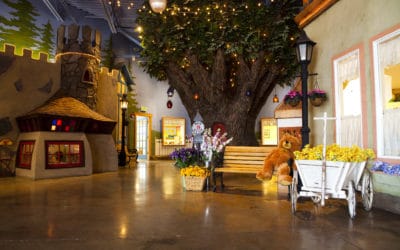
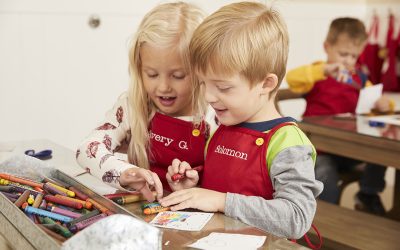
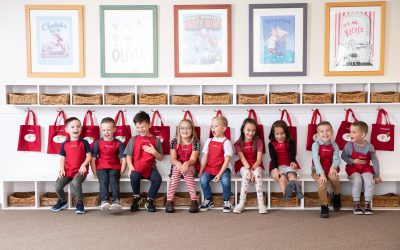
Young children learn through their senses and their surroundings. A classroom that feels like a classroom produces a certain kind of experience. A storybook village with cobblestone paths, cottage-style classroom storefronts, twinkle lights, a life-sized oak tree at the center of a “town square,” and themed workshop rooms (including a fully-equipped gourmet kitchen, science lab, art studio, and music and drama room) produces a fundamentally different one. Children at Kids Village wear red aprons embroidered with their names and receive a personalized book bag on their first day. These details are not decorations, but instead signal to a young child that this place was built for them.
Charter preschool spaces are typically housed within existing school buildings, designed first for older students. The space is functional. It serves its purpose. What it rarely does is make a four-year-old feel like they have stepped into somewhere magical — and that feeling shapes a child’s relationship with learning in magical ways.
What Utah Valley Parents Should Ask Before Choosing
Before committing to any preschool, private or charter, the right questions will tell you more than any brochure. Here are the ones that matter most:
What does a typical day actually look like?
Ask for a detailed description, or better yet, visit during a school day. The difference between a school that talks about “hands-on learning” and one that actually delivers distinct activity-based workshops every day becomes obvious when you see both in person.
How does the school measure academic progress?
Private schools are not required to follow state assessment schedules, which means they can choose more frequent or more meaningful measures of where a child is growing. Ask what the school tracks, how often, and how they communicate progress to families.
What happens if my child learns differently?
Kids Village was founded specifically on the belief that children grow or shrink into the labels and love we provide them. That origin shapes how the school approaches every child. Before you enroll anywhere, ask directly: what does this school do when a child struggles, and what does it do when a child is ready to move faster?
What do other Utah County families say?
Kids Village has been voted Best Preschool in Utah County every year from 2016 through 2026 by Utah residents. That recognition comes from families in Orem and across Utah County who saw what happened to their children and told their neighbors.
Frequently Asked Questions
Is there a charter preschool in Orem, Utah, and how does it compare to Kids Village?
Charter school preschool programming in Utah varies significantly by district and program, and availability in Orem specifically depends on current state and district offerings. What families consistently find when they compare options is that the academic depth, physical environment, and individual attention available at a private preschool like Kids Village are difficult to replicate in a publicly funded model. The charter model is designed to serve the broadest possible population within a standardized framework. Kids Village is designed around the specific child standing in front of the teacher that day. Those are genuinely different things, and for many Orem families, that distinction is exactly why they choose private.
For more answers to common enrollment questions, visit our frequently asked questions page.
Does private preschool in Utah prepare children better academically than a charter program?
The honest answer is that it depends on the private school. Not every private preschool offers a rigorous academic curriculum. What separates Kids Village is the five-senses learning and Saxon early math and reading programs. These science-backed and nationally rated curriculum models systemically build reading, phonics, and math skills starting at age 2½. Children who complete the Kids Village program regularly enter public school ahead of their grade-level peers in Utah County. Charter programs follow state standards, which establish a helpful baseline. The Saxon curriculum, paired with five-senses learning across daily workshops, goes well beyond that baseline.
What age can my child start at Kids Village, and are there openings?
Kids Village serves children from age 2½ through 2nd grade. The youngest learners start in the Little Sprouts early preschool program, designed specifically for children just beginning their school experience. Availability changes throughout the year, and because Kids Village has maintained full enrollment since 2008, openings do fill quickly. The best way to find out whether a spot is available for your child is to view our registration and tuition page.
What makes Kids Village different from other preschools in Utah County?
Several things, taken together, set Kids Village apart from other preschool options in Utah County. The storybook village environment is unlike anything else in the region — a purpose-built space with cobblestone paths, themed workshop rooms, and a life-sized oak tree at the center of the school. The Saxon curriculum delivers academic depth that most preschools do not attempt. The five-senses learning approach means children are never passive participants. And the school’s track record speaks for itself: Kids Village has been awarded Best Private Preschool in Utah every year from 2015 through 2026, with a 4.9-star Google rating driven by Utah County families who have watched their children thrive here. Those outcomes, sustained over more than two decades, are what make the choice clear for so many parents.
How much does private preschool at Kids Village cost, and is it worth the investment compared to a free charter option?
Many parents tell us tuition at Kids Village is significantly less than they expected, with 2026-27 school year fees starting at only $219/month for T/Th half-days, $429/month for 5 half-days, and $689/month for 5 full-days. Tuition information and current availability can be found on the Kids Village registration page. What families consistently tell us is that the value becomes clear quickly, not just in what their child learns, but in how their child feels about going to school. A child who leaves for school excited, returns home with stories about what they built or cooked or performed, and begins reading ahead of their kindergarten classmates is delivering a return that is hard to price. The cost difference between a free charter option and private tuition is real. So is the difference in what your child experiences every day.
Ready to See the Difference for Yourself?
Utah County families have trusted Kids Village for more than 20 years, and the school’s reputation across Orem and the broader Utah Valley community has been built one child at a time. If you are weighing your preschool options and want to understand what a private preschool education actually looks like in practice, the best next step is simple.
Schedule a tour at Kids Village. Walk the cobblestone paths. Watch a workshop in action. Ask every question on your list. The school was built to show families exactly what it offers, and the environment has a way of making the decision feel clear.
About the Author

Mikelle Despain
Author at Kids Village
Mikelle Despain has contributed expert articles on early childhood education to Kids Village for over a decade. With a background in child care and child development, as well as firsthand experience as a mother of four, she offers thoughtful, family-centered insight to help support parents and young learners.
You may also be interested in...

Age-Appropriate Garden Chores for Young Children
Spring is (nearly) upon us, which means planting season is just around the corner! Involving your child in growing a vegetable garden provides many emotional, educational, and physical benefits to the child, regardless of age! Young babies can benefit from sensory...
8 Reasons Why It’s Important for Children to Help in the Garden
Encouraging your child to help you in the garden doesn’t only get them outside; it also extends their attention span, teaches them delayed gratification, and more.

Presidents Day for Kids
As far as holidays go, Presidents Day isn't one that springs to mind as a "kids holiday," especially right after a candy-filled Valentine's Day. However, it's an important holiday in our history, and with a little creativity, it can be fun for your children! What is...

Strengthening Pre-Writing Skills at Home
Many of our parents ask what they can do at home to help their children excel at school, and our answer is almost always to READ! Reading is so, so important for students. Reading with your child not only helps to develop their language skills, but it also helps...
4 Things You Might Have Missed During Your Kids Village Tour
At Kids Village, we invite prospective families to come to our school for a tour at any time (you don't even have to give us notice if you come during school hours). We think it's important for parents and children to see classrooms and workshops in action as part of...
12 Ideas for Keeping Children Occupied on Thanksgiving
We don't know about you, but Thanksgiving can be...well...a little chaotic at our houses, especially with so many little ones in the mix. while it can be tempting to turn on a movie marathon and settle the kids onto beanbag chairs with a little Chex mix (no judgment...
Helping Your Child Transition Into Preschool
Transitioning into preschool can be scary for the parent, but it can be especially cumbersome for young children. They haven’t been exposed to many new things before, and you, as their parent, have been such a consistent presence in their life that it may be difficult...
How to Teach Kids to Share
Any time there is more than one child in the room, there’s likely to be some tension over some knick-knack or other. Kids under the age of 5 are just starting to develop their sense of self. They’re starting to explore and experiment with what that means for them and...

4 Ways to Enhance Your Child’s Ability to Focus
Being able to focus helps increase productivity, reduce stress, and helps you produce a better quality of work. When you are able to pay attention to just the task at hand, you’re able to dedicate your whole self to whatever it is you’re doing. Cultivating mindfulness...
How to Raise Self-Motivated Children
Raising kids who have the wherewithal to work past challenges and persevere can be a fine line to walk. You don’t want to be overbearing and force your kids to succeed; that’s a miserable and exhausting experience for both of you. It’s a balancing act: giving your...
5 Life Skills to Start Teaching Now
Parents have a lot of responsibility. We have to address our children’s immediate needs: feeding them (which sometimes feels nonstop), clothing them, and educating them. Outside of conventional education like learning the ABCs, multiplication tables, and the formula...

Six Toddler Friendly Science Experiments
Six Toddler-Friendly Science Experiments Cultivating your toddler’s interest in science may seem a bit overwhelming. They don’t have a lengthy attention span. Their limited interactions mean that there’s not much foundational knowledge from which to build, but that...