Ask most parents what preschool "should" look like, and many will describe a small child sitting at a table, pencil in hand, tracing letters on a worksheet. It is a familiar image. It is also, according to decades of early childhood research, one of the least effective ways to help young children learn. At Kids Village™, we built our entire approach around the opposite idea: that children under eight learn best when their whole body is involved, not just their eyes and their grip. That philosophy is what we call five-senses learning, and it is the foundation of our award-winning curriculum. If you have ever wondered what actually happens inside the little storybook village on North State Street in Orem, this article is your answer.
Our curriculum was designed from the ground up to engage children through sight, sound, touch, taste, and smell, because that is how young minds are wired to process and retain new information. Every lesson, every workshop, and every activity at Kids Village connects academic content to a real, physical, sensory experience your child will remember long after the school day ends.
Voted Best Preschool in Utah County, 2016–2026, Kids Village has been serving families throughout Utah County since 2003 — at our private preschool in Orem, Utah, where five-senses learning is not a supplement to the curriculum. It is the curriculum.
In This Article
Why Worksheets Fall Short for Young Learners What Five-Senses Learning Actually Means How We Put It Into Practice Every Single Day The Role of the Storybook Village Environment What the Research Says About Multisensory Learning What Kids Village Children Take Away Frequently Asked QuestionsWhy Worksheets Fall Short for Young Learners
There is nothing wrong with a pencil. Your child will need one. But a preschool or kindergarten experience built primarily around paper-based tasks misses something fundamental about how children between the ages of two and eight actually develop.
Young children are in a critical window of neurological growth. Their brains are forming connections at a rate that will never again be matched in their lifetime. During this window, the most powerful learning happens through direct, concrete experience. When a child touches something rough and hears the word "texture," the word sticks. When a child smells cinnamon while learning about spices from around the world, the geography lesson becomes a memory. When a child counts real objects with their hands rather than symbols on a page, the math concept moves from abstract to real.
Worksheets, by contrast, ask children to work at the symbolic and abstract level before they have built the concrete foundation that makes symbols meaningful. For many children, especially those who are kinesthetic learners, auditory learners, or children with developing language skills, worksheet-heavy instruction does not just fail to teach. It teaches children that learning is hard, dull, and something that happens to you rather than something you do.
That distinction matters deeply to the families who choose our private preschool in Orem Utah, and it is why so many Utah County parents specifically seek out a program built around active, sensory-rich learning.
What Five-Senses Learning Actually Means
Five-senses learning is exactly what it sounds like: a deliberate, structured approach that routes every academic concept through as many of the five senses as possible. It is not "free play with a learning label." It is purposeful, teacher-guided instruction that uses the full sensory environment as the medium.
At Kids Village, this means:
- Sight goes beyond looking at a board. Children observe experiments, examine specimens, watch things grow in the garden, and navigate the visually rich storybook village environment itself. Visual input is layered with context, not presented in isolation on a flat page.
- Sound is woven into learning through music, rhythm, language, and storytelling. Children learn phonics through songs. They experience history through stories and role-playing, and incorporate life values into learning.
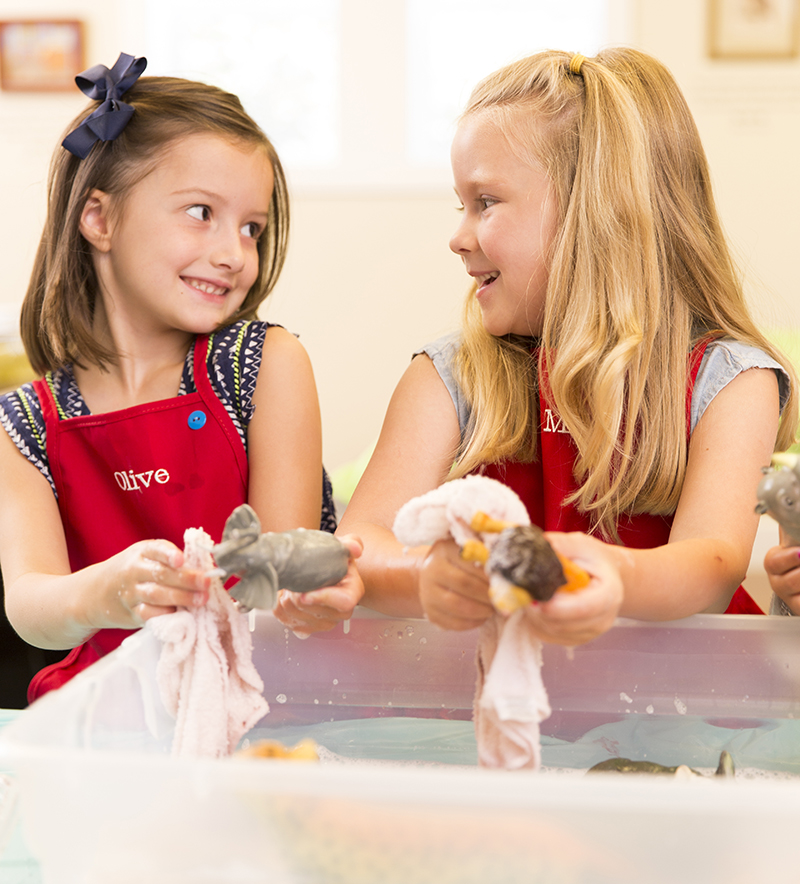
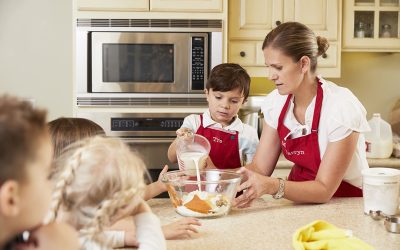
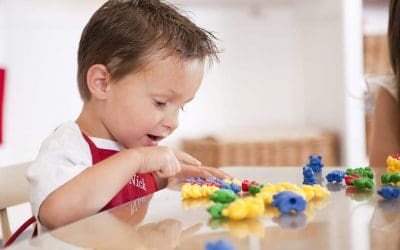
- Touch is one of the most powerful and most underused senses in traditional early education. At Kids Village, children handle real materials. They knead dough in the cooking studio. They plant seeds in the garden. They build, sort, stack, and manipulate objects in ways that make abstract concepts concrete and memorable.
- Taste and smell are integrated intentionally, particularly in cooking and science activities. When children taste what they have made or smell the ingredients in a lesson, they create a sensory anchor for the learning that no worksheet can replicate. Parents often tell us that their children still talk about specific cooking projects months later, which is not an accident. Taste and smell are processed in the same part of the brain that handles long-term memory.
This is what separates five-senses learning from supplemental enrichment. It is not an add-on. It is the architecture of the entire school day.
How We Put It Into Practice Every Single Day
One of the most common questions from Utah County families visiting Kids Village for the first time is, "How do you actually fit all of this into a school day?" The answer is in our workshops and incremental learning. Students rotate between academic and workshop classrooms each day, building on familiar themes and curriculum throughout each method of learning.
Rather than spending the school day in a single classroom rotating between subjects on a schedule, children at Kids Village move through a variety of themed workshop spaces. Each workshop targets a different domain of learning and a different combination of senses. The variety is intentional. It mirrors the way young children naturally engage with the world: in short, intense bursts of focused curiosity, not in long passive stretches.
Our workshop spaces include a kitchen and cooking studio, a science lab, an art studio, a computer lab, and a music and drama room, among others. In the cooking studio, a math lesson about fractions becomes a recipe. In the science lab, a lesson about the water cycle might involve mist, color, and temperature. In the drama room, a history concept becomes a performance. These are not isolated fun activities bolted onto a "real" curriculum. They are the curriculum, expressed through hands-on, multisensory experience.
To explore how these workshops connect across program levels from our youngest Little Sprouts to our Grade School students, visit our programs page and explore our programs in detail.
The Saxon Early Learning curriculum we use, consistently rated among the top three early childhood academic programs nationally with over 30 years of proven results, provides the academic backbone that gives our five-senses approach its structure and rigor. Families should not mistake multisensory learning for an absence of academic ambition. Children at Kids Village cover reading, phonics, math, science, and history alongside life skills including cooking, music, foreign language, drama, gardening, and personal values. They leave us consistently ahead of grade-level peers in public school settings.
The Role of the Storybook Village Environment
Environment is not decoration at Kids Village. It is pedagogy.
The moment your child walks through the doors at 1641 N. State Street in Orem, they enter a space unlike any other school in Utah Valley. Cobblestone paths wind through a village of cottage-style classroom storefronts lit by twinkle lights. At the center of it all stands a life-sized oak tree, the visual heart of a space designed to make learning feel like an adventure rather than an obligation.
Why does this matter for learning? Because young children are exquisitely sensitive to their environment. A child who feels wonder in their surroundings is a child whose brain is primed for curiosity. A child who looks forward to walking into school is a child who arrives open, engaged, and ready to learn. The storybook village is not whimsy for its own sake. It is a carefully constructed context that reinforces everything we know about how emotion, environment, and memory work together in early childhood.
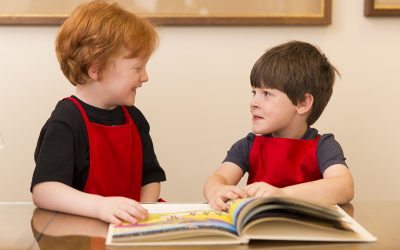
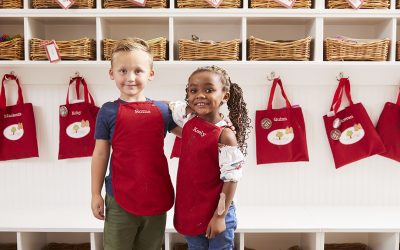
Each child receives a personalized book bag as a welcome gift and wears a red apron embroidered with their name, as do our teachers. These small details create a sense of belonging and identity that is itself a form of learning: your child is a valued member of this community, and this place was made for them.
For families across Utah County and the broader Orem area visiting for the first time, the most common response we hear is that the space does not look like any school they have ever seen. That is entirely by design.
About the Author

Mikelle Despain
Author at Kids Village
Mikelle Despain has contributed expert articles on early childhood education to Kids Village for over a decade. With a background in child care and child development, as well as firsthand experience as a mother of four, she offers thoughtful, family-centered insight to help support parents and young learners.
You may also be interested in...
Phrases to Encourage a Growth Mindset in Children
"Developing a growth mindset." You’ve probably heard this phrase kicked around, but why is it so important? A growth mindset is the opposite of a fixed mindset. Those who have developed fixed mindset are likely to believe one thing: "it’s out of their control." Those...
Common Fears Children Have & How You Can Help
Children are constantly exposed to new sights, sounds, and experiences, and some of them can be overwhelming and scary. Children pick things up quickly, but some of these experiences might leave them a little anxious and unsure. Keep in mind, above all, that their...
Ways To Slow Down And Enjoy Parenting
In such a fast-paced world, a moment of downtime with your kids is hard to find. You may be with them all day -driving them to soccer practice, to gymnastics, or the physician--but how much time are you spending with them? The cliche saying that children grow up too...

15 Summer Screen Free Activity Ideas
When summer break roles around, we suddenly have extra hours to keep our kids entertained. It can be difficult to find activities that are interesting enough to surpass the pull of a TV show or video game. It’s hard to come up with alternatives when your child is...
4 Strategies for Teaching Children to Resolve Sibling Fights on Their Own
Teaching Children to Resolve Sibling Fights on Their Own Where there is communication, there are disagreements, disputes, and misunderstandings. This underlines the significance of teaching your children how to resolve conflicts effectively and independently. This...
Counting Bears – The Importance of Manipulatives in Early Childhood Math
At Kids Village, you may have seen that we use bear counters to help teach math to our Sweet Peas, Little Sprouts, and Tater Tots. While bear counters are cute and colorful, we love them for more than just their aesthetics. Hands-On Learning These bear counters are...
Teaching Children Gratitude
Gratitude is about more than an automatic "please" and "thank you" response when someone does something kind for you. Teaching children gratitude is about helping them learn to understand that in order to receive, someone else must give. It means when someone does...
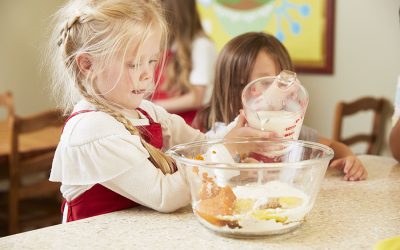
Teaching Your Child to Cook: Age Appropriate Kitchen Skills
Cooking is not only a fun activity to do with your child; it’s also an important life skill for them to learn! You’ve probably already started letting your child help with things like stirring and pouring, but at what ages can you start adding additional skills?...
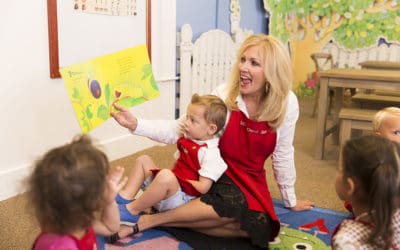
About Kids Village Monthly Values
At Kids Village, we believe that early childhood education encompasses not just the mind, but the heart and soul as well. Our goal is to raise the children in our school up so they have the confidence and mindsets to believe they can achieve anything they want in...
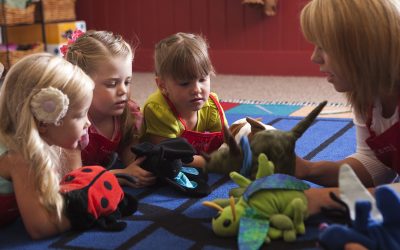
9 Tips for Becoming a More Playful Mom
The best way to help your child thrive is by spending time with them. By engaging with them, you stimulate their imagination, boost their confidence, and strengthen that connection that you both need. 9 Tips for Becoming a More Playful Mom For some of us, being...
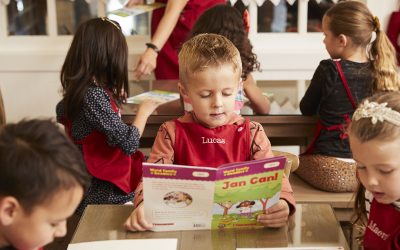
Tips for Helping Your Child Love Reading
Reading is so important in your child’s development. Not only is it critical in language development, but it also helps build social skills, communication skills, stimulates creativity, sparks their imagination, improves focus, and introduces problem-solving skills....
How to Raise a Grateful Child
Gratitude is important for adults and children alike. Not only is it good for our bodies, but it also makes us happier and less susceptible to depression, makes us more resilient, and is good for society. For children, gratitude is an important lesson in their...